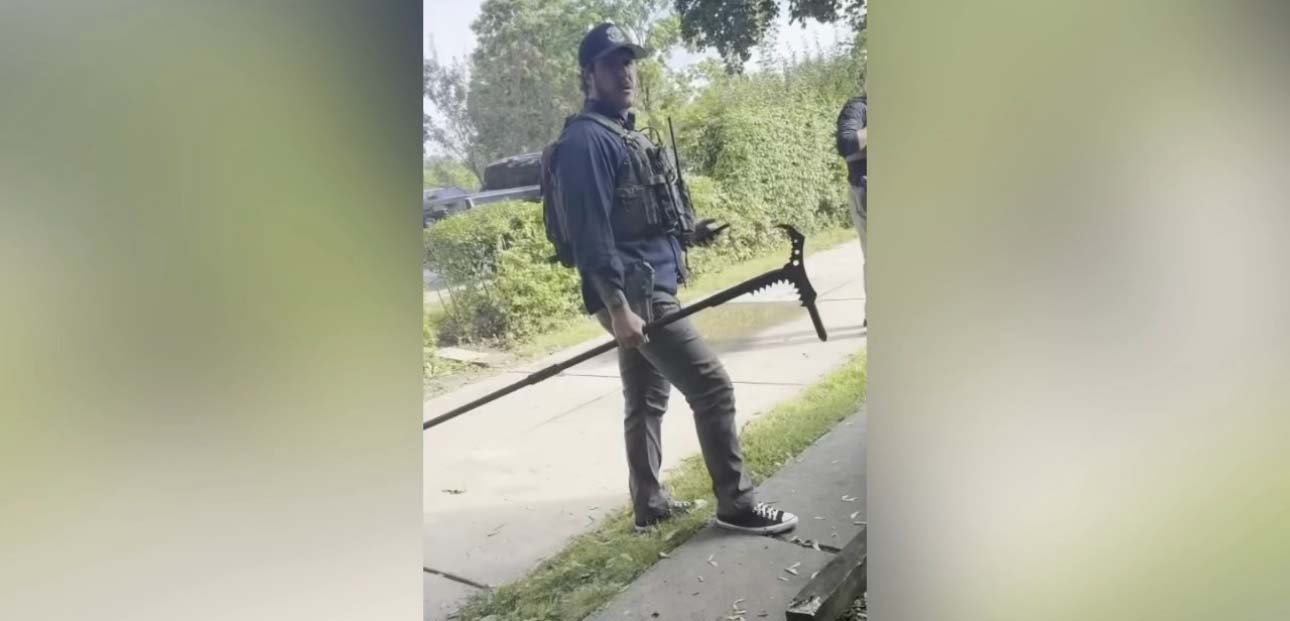
Violent Abuse of Power
This did not happen because of confusion.
It did not happen because of paperwork.
It did not happen because “the system is complicated.”
It happened because power was exercised against a family that had already spoken out, and the normal constitutional barriers meant to protect them were treated as obstacles to work around.
At the center of this is Deputy U.S. Marshal Brett Fimbinger.
Not an abstract agency.
Not “law enforcement” as a concept.
A named federal officer whose signature appears on the documents, whose actions are described in sworn materials, and whose presence is tied directly to harm, trauma, and injury. Conrad and Adrienne Rockenhaus will live with this for the rest of their lives, if Conrad makes it out alive at all.
(See the illegal, “judge-shopped” warrant signed by Brett Fimbinger here)
What Actually Happened
On September 4, 2025, a violent raid was carried out against Conrad and Adrienne Rockenhaus, at Adrienne Rockenhaus’s second sanctuary home. It is important to note that this was not Conrad’s home, nor was this home registered with probation.
There was no federal search warrant issued by a federal judge authorizing the entry and search that occurred.
Instead, Brett Fimbinger personally swore out an affidavit for a state search warrant, signed by a Lenawee County circuit court judge, and that state warrant was used to execute a federal enforcement action.
This matters in a big way.
It matters because federal officers are not allowed to bypass federal judicial review by borrowing state authority when it is more convenient.
It matters because the Fourth Amendment does not disappear when jurisdiction becomes inconvenient.
And it matters because the family targeted by this action had already engaged in protected activity, including legal complaints and civil rights claims, against the same federal actors. They then returned to commit violent acts against the family, with an illegal warrant.
Why This Is Judge Shopping
Judge shopping is not a technical term invented by advocates. It describes a very real abuse of power:
When an officer seeks out a different court, jurisdiction, or judge to obtain authority that would not be granted through the proper legal channel.
That is exactly what has happened here.
Instead of presenting facts to a federal judge and obtaining a federal search warrant, Brett Fimbinger went to a state court and obtained a state warrant that was then used in a federal operation.
This is not a clerical error.
This is not harmless overlap.
This is a deliberate choice.
And when constitutional safeguards are treated as optional, people get hurt.
The Human Cost of This Choice
Conrad Rockenhaus is a disabled veteran with a service-connected TBI.
During the raid, he suffered a new traumatic head injury. He later experienced seizures from it later that day in court. His neurological condition deteriorated. He was placed in conditions that exacerbated his injury instead of receiving medical care. He is now seizing to death in the SHU.
Adrienne Rockenhaus did not simply witness a search or a raid. She describes terror, violence, armed intimidation, and conduct that left lasting psychological damage.
These are not speculative harms.
They are lived consequences.
And they did not stop when the raid ended.
Why Naming Brett Fimbinger Matters
Victims are routinely told that harm was caused by “the system,” by “policy,” or by “process.”
That language protects perpetrators.
Systems do not swing doors open.
Systems do not swear affidavits.
Systems do not point guns.
People do.
Brett Fimbinger’s name appears:
- on the affidavit for the state search warrant,
- on the return of the federal arrest warrant,
- and throughout the record describing the operation.
If harm occurred, it did not occur anonymously.
And if accountability is ever going to exist, names cannot be erased in favor of abstractions.
Why This Is Dangerous Beyond One Family
When federal officers learn that they can:
- avoid federal judicial scrutiny,
- obtain authority from a more convenient court,
- and face no immediate consequence even after harm,
that behavior does not stay isolated.
It becomes precedent in practice, if not in law.
That is how rights erode, not through dramatic declarations, but through repeated acts that go unchallenged because the victims are told to be quiet, patient, or grateful they survived.
Disabled people are especially vulnerable to this erosion.
Women who speak out are especially vulnerable to retaliation.
History shows where this trajectory leads when it is normalized.
Silence Is Not Neutral
The documents, videos, audio recordings, and sworn materials related to this raid have been public for months.
The risk was known.
The harm was visible.
The warnings were explicit.
When no corrective action follows, silence becomes participation.
Not because it proves guilt in a courtroom sense, but because it allows harm to continue without restraint.
This Is Not About Revenge
This is about drawing a line.
A line that says:
- the Constitution still applies when it is inconvenient,
- disabled veterans are not acceptable collateral,
- women who report abuse are not legitimate targets,
- and officers do not get to shop for judges when they don’t like the answer they might receive.
If that line is not drawn here, it will not be drawn elsewhere.
Conclusion
This is why the warrant matters.
This is why the method matters.
This is why Brett Fimbinger’s actions matter.
Because when power is exercised without accountability, the damage does not end with one family.
And because Conrad and Adrienne Rockenhaus deserved protection, not a system that treated their lives as obstacles.
WATCH BRETT FIMBINGER ADMIT “NO WARRANT” AFTER BEATING DISABLED VETERAN CONRAD ROCKENHAUS UNCONSCIOUS AND ARRESTING HIM ON FALSE TECHNICAL VIOLATIONS: